
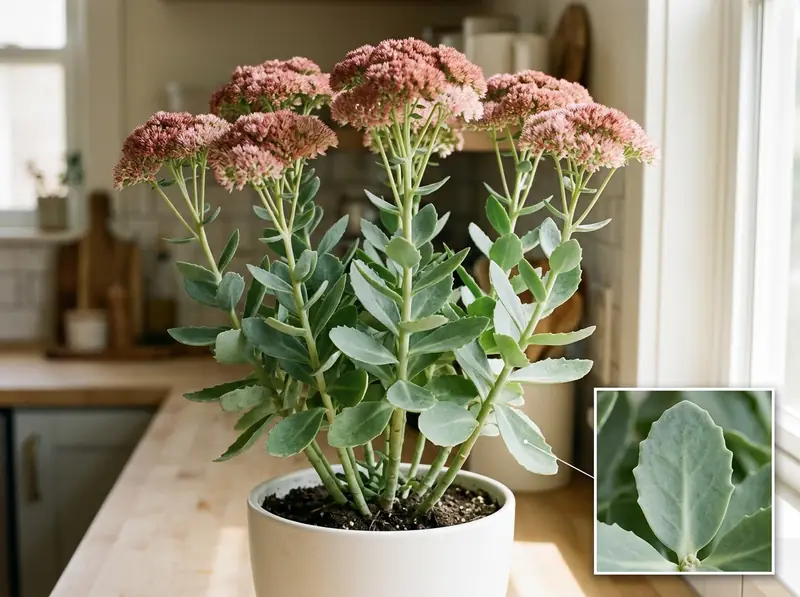
 AI-generated
Autumn Joy
Sedum spectabile
Autumn Joy is a tough, upright sedum with thick gray-green leaves and broad flower heads that open pink and deepen to rusty red in fall. It is really a hardy perennial, so it does best in a sunny window or outdoors in a pot, with a cold winter rest. Water sparingly and give it plenty of sun.
Saving is free with a KinClub account, and it works here and in the KinClub app. Sign up free
Care profile
- Light
- Direct sunLow → direct sun
- Water
- Let it dry outAbout every 14 days
- Difficulty
- EasyTricky → easy
- Coldest it tolerates
- 30°F
- Humidity
- Low
- Mature size
- MediumSmall → tree-size
- Growth rate
- Moderate
- How common
- CommonRare → everywhere
- Plant family
- Crassulaceae
Pets and toxicity
Cats and dogs: not yet checked
Not yet checked against ASPCA — don't assume it's safe for pets.
No toxicity source on record for this plant yet. If a pet eats any houseplant, call your vet or an animal poison helpline.
How to care for Autumn Joy
Light
Give it at least 6 hours of direct sun, such as a south-facing window or a bright spot outdoors in summer. Weak light makes the stems leggy and floppy.
Watering
Water thoroughly, then let the soil dry out almost completely before watering again, roughly every 10 to 14 days in summer. In winter dormancy, water only a few times, just enough to keep the roots from shriveling.
Soil
Use a gritty cactus or succulent mix, or add about one third perlite or coarse sand to ordinary potting mix. The pot must have drainage holes.
Feeding
Feed lightly, if at all: a half-strength balanced fertilizer once in spring and once in early summer. Too much feeding gives weak, floppy stems.
Repotting
Repot every 2 to 3 years in early spring, moving up only one pot size (about 2 inches). Divide crowded clumps at the same time.
Propagation
Take 3 to 4 inch stem cuttings in late spring or summer, let the cut ends dry for a day, and stick them in gritty mix. They root in 2 to 4 weeks. You can also divide clumps in spring.
Common problems
- Floppy, leggy stems: move to a sunnier spot and avoid extra fertilizer; pinch stems back in late spring to keep them sturdier.
- Base rot or mushy stems: water less, use a grittier mix, and cut away rotted tissue; replant healthy cuttings.
- No flowers: usually too little sun or too much warmth in winter; give full sun and a cold winter rest.
- Aphids or mealybugs on buds and stems: wipe with rubbing alcohol on a cotton swab or spray with insecticidal soap.
Similar plants
Same light needs and difficulty.
 AI-generated
 AI-generated
 AI-generated
 AI-generated