
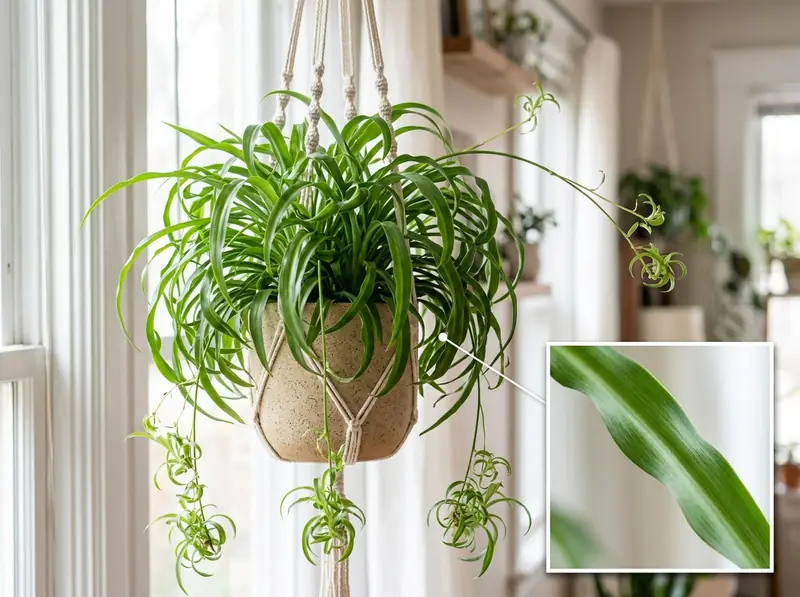
 AI-generated
Curly Spider Plant
Chlorophytum comosum 'Bonnie'
'Bonnie' is the curly spider plant, a compact form with tightly waved, arching green leaves that make a fuller, bouncier clump than the straight-leaved type. It is forgiving and quick to grow, and it sends out dangling plantlets that are easy to pot up. It looks best in a hanging basket or on a shelf in bright indirect light.
Saving is free with a KinClub account, and it works here and in the KinClub app. Sign up free
Care profile
- Light
- Bright, indirect lightLow → direct sun
- Water
- Moderate wateringAbout every 7 days
- Difficulty
- EasyTricky → easy
- Coldest it tolerates
- 45°F
- Humidity
- Medium
- Mature size
- SmallSmall → tree-size
- Growth rate
- Fast
- How common
- CommonRare → everywhere
- Plant family
- Asparagaceae
Pets and toxicity
Non-toxic to cats
Listed as non-toxic to cats by the ASPCA.
Non-toxic to dogs
Listed as non-toxic to dogs by the ASPCA.
Source: ASPCA toxic and non-toxic plants. If a pet eats any houseplant, call your vet or an animal poison helpline.
How to care for Curly Spider Plant
Light
Bright indirect light suits it best, such as a spot near an east or north-facing window. It tolerates medium light but grows more slowly, and direct afternoon sun can scorch the leaves.
Watering
Water when the top inch or so of soil feels dry, roughly weekly in spring and summer and less often in winter. The thick, fleshy roots store water, so it handles occasional dry spells better than soggy soil.
Soil
Use an ordinary well-draining potting mix, ideally with some perlite added. The pot must have drainage holes.
Feeding
Feed every 4 to 6 weeks in spring and summer with a balanced liquid houseplant fertilizer at half the label strength. Skip feeding in winter, as too much fertilizer causes brown tips.
Repotting
Repot every 1 to 2 years, or when the thick roots fill the pot or push up out of the soil. Go up only one pot size, about 1 to 2 inches wider, in spring.
Propagation
Snip off the small plantlets (spiderettes) that hang from the long stems and root them in water or pot them in moist soil. They usually root within 2 to 4 weeks. You can also divide a large plant at repotting.
Common problems
- Brown leaf tips: caused by salts, fluoride or chlorine in tap water, or by dry soil. Use filtered or rainwater and flush the soil occasionally, then trim the brown tips.
- Pale or plain green leaves on a variegated plant: light is too low. Move it to a brighter spot with indirect light.
- Yellow, soft leaves: overwatering or poor drainage. Let the soil dry, empty the saucer, and check the roots for rot.
- No plantlets: the plant may be too young, root-bound not enough, or in too little light. Give it brighter light and let it get slightly pot-bound.
- Sticky leaves or webbing: aphids, scale or spider mites. Wipe leaves with soapy water or use insecticidal soap, and repeat weekly.
Similar plants
Same light needs and difficulty.
 AI-generated
 AI-generated
 AI-generated
Chinese Money Plant
Pilea peperomioides
- Bright, indirect light
- Dry to moderate watering
Pets: not yet checked AI-generated
Christmas Cactus
Schlumbergera × buckleyi
- Bright, indirect light
- Moderate watering
Pets: not yet checked