
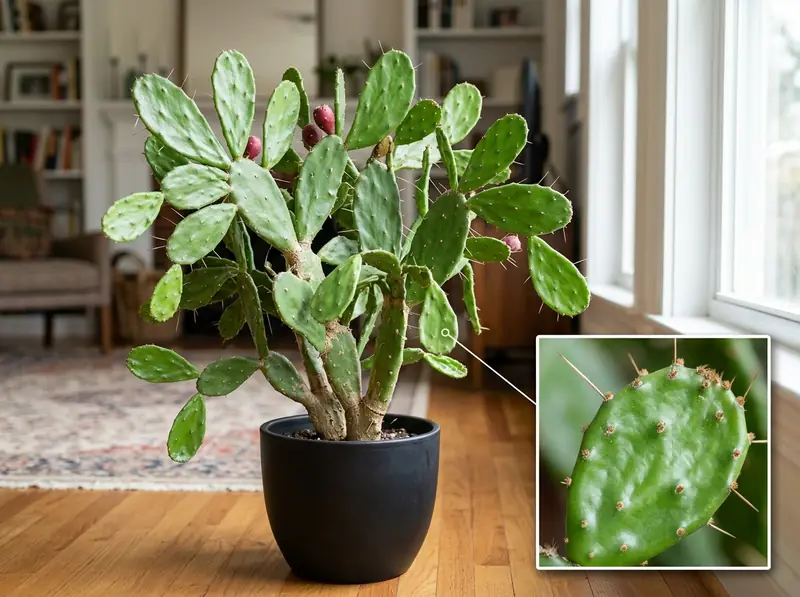
 AI-generated
Drooping Prickly Pear
Opuntia monacantha
Also known as Opuntia arechevaletae, Opuntia lemaireana, Opuntia monocantha
Drooping prickly pear is a tall, branching cactus with flat green pads, yellow flowers and red fruit when mature. It needs lots of direct sun and very little water, so it suits a bright south-facing window. Handle it carefully with thick gloves, as the tiny glochids are easy to pick up.
Saving is free with a KinClub account, and it works here and in the KinClub app. Sign up free
Care profile
- Light
- Direct sunLow → direct sun
- Water
- Let it dry outAbout every 21 days
- Difficulty
- EasyTricky → easy
- Coldest it tolerates
- 35°F
- Humidity
- Low
- Mature size
- LargeSmall → tree-size
- Growth rate
- Moderate
- How common
- EnthusiastRare → everywhere
- Plant family
- Cactaceae
Pets and toxicity
Cats and dogs: not yet checked
Not yet checked against ASPCA — don't assume it's safe for pets.
Source: ASPCA toxic and non-toxic plants. If a pet eats any houseplant, call your vet or an animal poison helpline.
How to care for Drooping Prickly Pear
Light
Give it at least 4-6 hours of direct sun, such as a south or west window, or a grow light if the window is weak. Move it gradually into stronger light to avoid sunburn.
Watering
Soak thoroughly only when the soil is completely dry, roughly every 2-4 weeks in spring and summer. In winter, water only once every 6-8 weeks or not at all.
Soil
Use a gritty cactus mix, ideally with extra perlite or coarse sand (about one-third to one-half) in a pot with drainage holes. Terracotta helps the soil dry quickly.
Feeding
Feed with a low-nitrogen cactus fertilizer at half strength about once a month from spring to late summer. Do not feed in autumn and winter.
Repotting
Repot every 2-3 years in spring into a pot only 1-2 inches wider, using thick gloves or folded newspaper to handle it. Wait a week before watering to let any root damage heal.
Propagation
Twist or cut off a pad, let the cut end dry and callus for 1-2 weeks, then set it upright in dry cactus mix. Water lightly after roots form in a few weeks.
Common problems
- Mushy, dark pads at the base are rot from overwatering; cut away all soft tissue with a clean knife, let it callus, and replant in dry gritty mix.
- Pale, stretched new growth means too little light; move to a sunnier spot or add a grow light.
- White cottony patches are mealybugs; dab them with rubbing alcohol on a cotton swab and repeat weekly.
- Small hard brown bumps are scale insects; scrape them off or wipe with alcohol and check again in a week.
- Tiny glochids (hair-like spines) can irritate skin; handle with thick gloves and tongs, and remove stuck ones with tape.
Similar plants
Same light needs and difficulty.
 AI-generated
 AI-generated
 AI-generated
 AI-generated