
 AI-generated
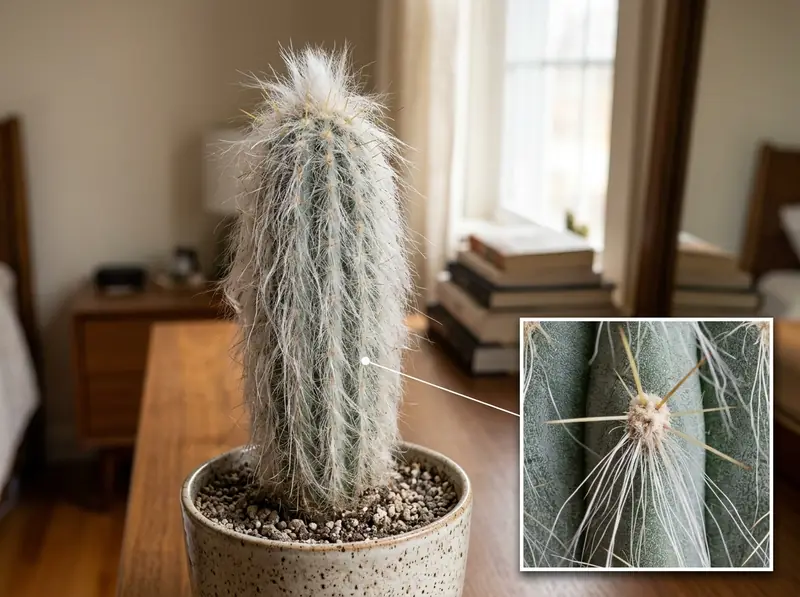
Old Man Cactus
Cephalocereus senilis
Old Man Cactus is a slow-growing columnar cactus covered in long, shaggy white hairs that give it a bearded look. It needs a sunny window, gritty soil and very little water. Indoors it stays compact for many years, and it is best kept dry in winter.
Saving is free with a KinClub account, and it works here and in the KinClub app. Sign up free
Care profile
- Light
- Direct sunLow → direct sun
- Water
- Let it dry outAbout every 21 days
- Difficulty
- Easy to moderateTricky → easy
- Coldest it tolerates
- 50°F
- Humidity
- Low
- Mature size
- Small to mediumSmall → tree-size
- Growth rate
- Slow
- How common
- CommonRare → everywhere
- Plant family
- Cactaceae
Pets and toxicity
Non-toxic to cats
Listed as non-toxic to cats by the ASPCA.
Non-toxic to dogs
Listed as non-toxic to dogs by the ASPCA.
Source: ASPCA toxic and non-toxic plants. If a pet eats any houseplant, call your vet or an animal poison helpline.
How to care for Old Man Cactus
Light
Give it at least 4-6 hours of direct sun, such as a south or west window. Acclimate it gradually to stronger light to avoid scorching, and turn the pot a quarter turn every few weeks.
Watering
In spring and summer, water thoroughly only when the soil is completely dry, roughly every 3-4 weeks indoors. In winter, water just once every 6-8 weeks or not at all, and keep the stem and hair dry.
Soil
Use a fast-draining cactus mix with extra pumice, perlite or coarse sand (about 50% mineral grit). Use an unglazed terracotta pot with a drainage hole.
Feeding
Feed with a low-nitrogen cactus fertilizer at half strength about once a month from spring to late summer. Do not feed in fall and winter.
Repotting
Repot every 2-3 years in spring, only when it is snug, into a pot 1-2 inches wider. Wear thick gloves or use folded newspaper to handle the spines, and wait about a week before watering.
Propagation
It is usually grown from seed, which is very slow. Offsets are rare, but a cutting from a branch or a top can be dried for 1-2 weeks until callused, then set on dry gritty mix to root.
Common problems
- Rot at the base from overwatering: cut away the healthy top, let it callus and re-root it in dry gritty mix.
- Mealybugs hide in the white hair: dab with cotton swabs dipped in 70% isopropyl alcohol and repeat weekly.
- Stretched, pale, pointed growth from low light: move to a sunnier window; the stretched section will not reverse.
- Brown scorched patches from sudden strong sun: move gradually to brighter light and shade it from harsh midday sun in summer.
- Dusty, dingy hair: brush gently with a soft, dry brush or use a hairdryer on cool setting.
Similar plants
Same light needs and difficulty.
 AI-generated
 AI-generated
 AI-generated
 AI-generated