
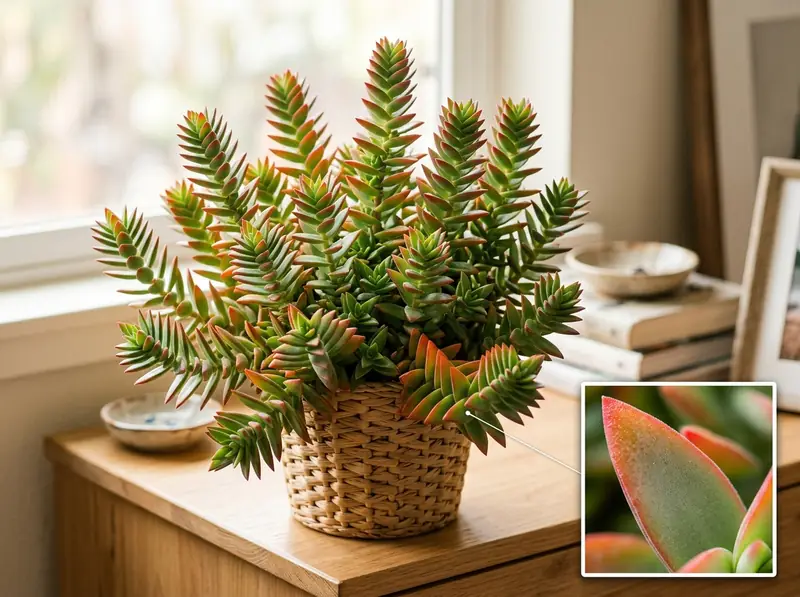
 AI-generated
Red Pagoda
Crassula capitella
Red Pagoda is a small succulent whose tightly stacked, triangular leaves form a spire-like column, with edges that blush red in strong light. It is easy to grow if given lots of sun, gritty soil and infrequent watering. Stems spread and clump over time, and it is easy to multiply from offsets.
Saving is free with a KinClub account, and it works here and in the KinClub app. Sign up free
Care profile
- Light
- Direct sunLow → direct sun
- Water
- Let it dry outAbout every 14 days
- Difficulty
- EasyTricky → easy
- Coldest it tolerates
- 40°F
- Humidity
- Low
- Mature size
- SmallSmall → tree-size
- Growth rate
- Moderate
- How common
- CommonRare → everywhere
- Plant family
- Crassulaceae
Pets and toxicity
Cats and dogs: not yet checked
Not yet checked against ASPCA — don't assume it's safe for pets.
No toxicity source on record for this plant yet. If a pet eats any houseplant, call your vet or an animal poison helpline.
How to care for Red Pagoda
Light
Give it at least 4 to 6 hours of bright light, including some direct sun, such as a south or west window. Acclimate it gradually to stronger sun to avoid scorching.
Watering
Soak the soil thoroughly, then let it dry out completely before watering again, usually every 10 to 21 days in the growing season. In winter water only about once a month, or less in a cool room.
Soil
Use a gritty cactus or succulent mix. Adding extra perlite or pumice (about one third by volume) improves drainage. Always use a pot with drainage holes.
Feeding
Feed with a half-strength cactus or balanced fertilizer about once a month in spring and summer. Do not feed in fall and winter.
Repotting
Repot every 2 to 3 years, or when the stacks crowd the pot, in spring. Choose a pot only 1 inch wider, and wait a week before watering so any root damage can heal.
Propagation
Pull off a stem segment or a rosette-stack offset and let the cut end callus for 2 to 3 days. Set it on dry gritty mix and water lightly only after roots form in a few weeks.
Common problems
- Leaves turn mushy and yellow at the base: this is root or stem rot from overwatering. Let the soil dry, cut away rotted parts and repot in fresh gritty mix.
- Plant becomes stretched and green: light is too low. Move it to a sunnier window, and pinch or cut back leggy stems to restart compact growth.
- White cottony clumps between the leaves are mealybugs. Dab them with cotton swabs dipped in rubbing alcohol and repeat weekly until gone.
- Lower leaves dry up and drop: a few at a time is normal aging. If it is many, check for underwatering or root problems.
Similar plants
Same light needs and difficulty.
 AI-generated
 AI-generated
 AI-generated
 AI-generated