
 AI-generated
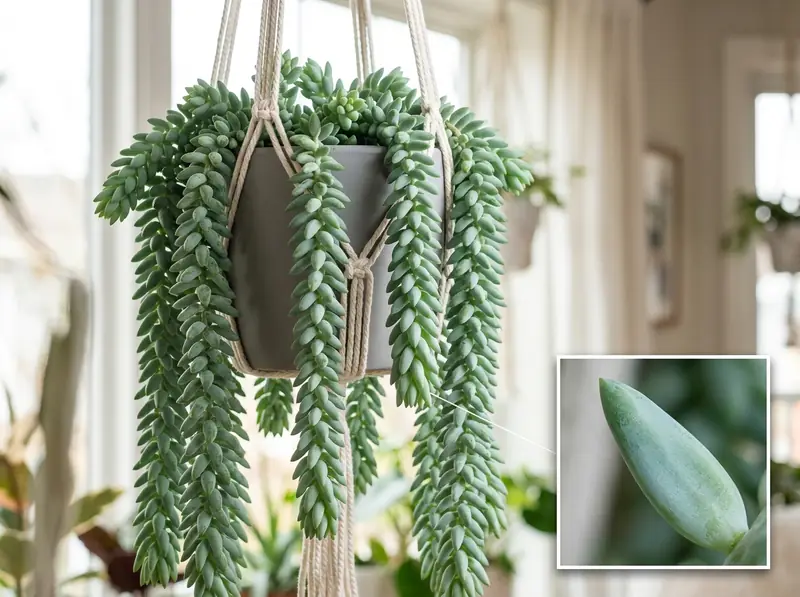
Burro's Tail
Sedum morganianum
Also known as Horse's Tail, Donkey's Tail, Lamb's Tail
Burro's tail is a slow-growing succulent with trailing stems covered in plump, blue-green, teardrop-shaped leaves. It does best in a sunny window with a gritty soil mix and infrequent watering. Its leaves fall off easily, so hang it somewhere it won't be bumped.
Saving is free with a KinClub account, and it works here and in the KinClub app. Sign up free
Care profile
- Light
- Direct sunLow → direct sun
- Water
- Let it dry outAbout every 14 days
- Difficulty
- EasyTricky → easy
- Coldest it tolerates
- 50°F
- Humidity
- Low
- Mature size
- Small to mediumSmall → tree-size
- Growth rate
- Slow
- How common
- Very commonRare → everywhere
- Plant family
- Crassulaceae
Pets and toxicity
Non-toxic to cats
Listed as non-toxic to cats by the ASPCA.
Non-toxic to dogs
Listed as non-toxic to dogs by the ASPCA.
Source: ASPCA toxic and non-toxic plants. If a pet eats any houseplant, call your vet or an animal poison helpline.
How to care for Burro's Tail
Light
Give it at least 4 to 6 hours of bright light, including some direct sun, such as a south or west window. Acclimate it gradually to stronger sun to avoid scorching.
Watering
Water thoroughly, then wait until the soil is completely dry, about every 2 to 3 weeks in spring and summer. In winter, water only about once a month, just enough to keep the leaves from shriveling.
Soil
Use a gritty cactus or succulent mix, ideally with extra perlite or pumice added. Use a pot with drainage holes; unglazed terracotta helps the soil dry faster.
Feeding
Feed with a half-strength cactus or balanced fertilizer once a month in spring and summer. Do not fertilize in fall and winter.
Repotting
Repot only every 2 to 3 years, in spring, when the pot is crowded. Handle gently because leaves fall off easily, and wait a week before watering.
Propagation
Lay fallen leaves on dry succulent mix, or take 3 to 4 inch stem cuttings. Let cuttings callus for a few days, then set them on or in gritty soil; roots form in a few weeks.
Common problems
- Leaves dropping when touched: this is normal fragility; avoid moving or brushing the plant, and do not try to reattach them.
- Mushy, yellow leaves or black stems: overwatering; cut off rotted parts, let the soil dry fully, and repot into gritty mix if needed.
- Long, sparse stems with gaps between leaves: too little light; move to a sunnier window.
- White cottony clusters in leaf crevices: mealybugs; dab them with a cotton swab dipped in rubbing alcohol and repeat weekly.
Similar plants
Same light needs and difficulty.
 AI-generated
 AI-generated
 AI-generated
 AI-generated