
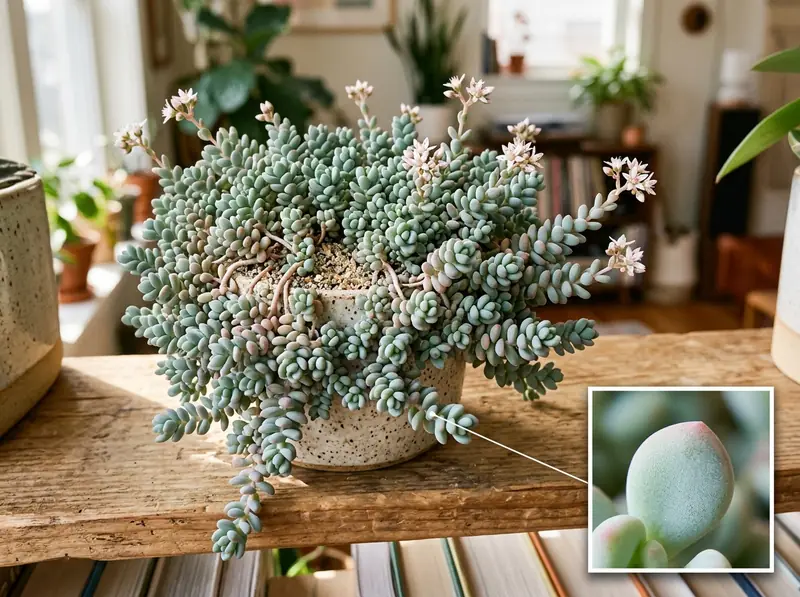
 AI-generated
Corsican Stonecrop
Sedum dasyphyllum
Corsican stonecrop is a tiny, mat-forming succulent with plump blue-green leaves that blush pink in strong sun, and small white flowers in summer. It is easy to grow on a bright, sunny windowsill in gritty soil, as long as you let it dry out fully between waterings. It prefers cooler conditions and does best with a cool winter rest.
Saving is free with a KinClub account, and it works here and in the KinClub app. Sign up free
Care profile
- Light
- Direct sunLow → direct sun
- Water
- Let it dry outAbout every 14 days
- Difficulty
- EasyTricky → easy
- Coldest it tolerates
- 30°F
- Humidity
- Low
- Mature size
- SmallSmall → tree-size
- Growth rate
- Moderate
- How common
- EnthusiastRare → everywhere
- Plant family
- Crassulaceae
Pets and toxicity
Cats and dogs: not yet checked
Not yet checked against ASPCA — don't assume it's safe for pets.
No toxicity source on record for this plant yet. If a pet eats any houseplant, call your vet or an animal poison helpline.
How to care for Corsican Stonecrop
Light
Give it at least 4-6 hours of direct sun, such as a south or west window. In lower light it stretches and loses its compact, blue-grey color.
Watering
Water thoroughly, then let the soil dry out almost completely before watering again, about every 2-3 weeks in summer. In winter, water only a little once a month or less.
Soil
Use a gritty cactus and succulent mix, or add about half perlite or coarse sand to regular potting soil. Use a pot with drainage holes.
Feeding
Feed lightly, at most 2-3 times in spring and summer, with a succulent fertilizer at quarter to half strength. Do not feed in winter.
Repotting
Repot every 2-3 years, or when the mat has filled the pot, in spring. A shallow, wide pot suits its spreading habit better than a deep one.
Propagation
Break off small pieces of stem or single leaves, let them dry for a day, and press them onto gritty soil. They root in 2-3 weeks. Keep the soil barely damp until they root.
Common problems
- Mushy, translucent leaves and stems mean overwatering or poor drainage. Cut off the rotted parts, repot in dry gritty mix and wait a week before watering.
- Stretched, sparse growth means too little light. Move it to a sunnier window or add a grow light.
- Fluffy white cottony spots are mealybugs. Dab them with a cotton swab dipped in rubbing alcohol and repeat weekly until they are gone.
- Dying center of the mat is common in older plants. Trim it out and replant healthy cuttings in fresh mix.
Similar plants
Same light needs and difficulty.
 AI-generated
 AI-generated
 AI-generated
 AI-generated