
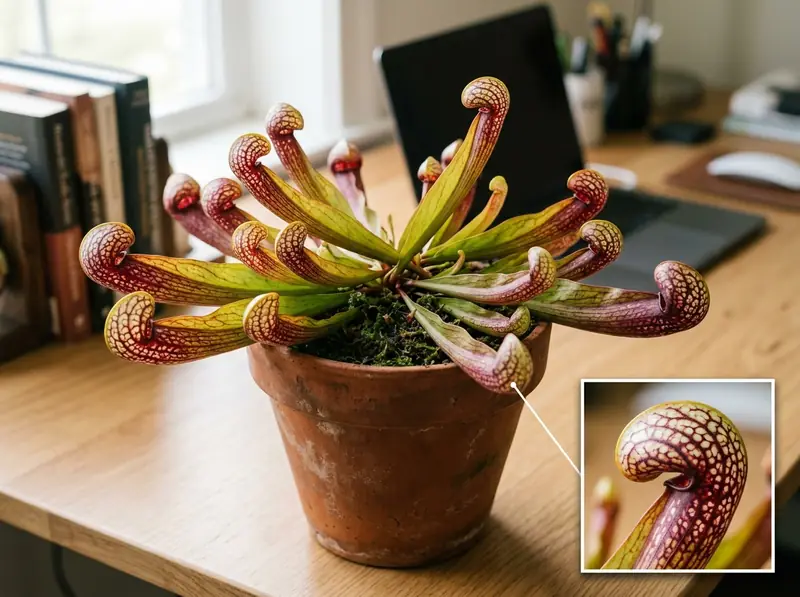
 AI-generated
Parrot Pitcher Plant
Sarracenia psittacina
Parrot pitcher plant (Sarracenia psittacina) forms low, curved pitchers shaped like a parrot's beak with white spotted hoods. It tolerates wetter conditions than most pitcher plants.
Saving is free with a KinClub account, and it works here and in the KinClub app. Sign up free
Care profile
- Light
- Direct sunLow → direct sun
- Water
- Keep moistAbout every 3 days
- Difficulty
- ModerateTricky → easy
- Coldest it tolerates
- 20°F
- Humidity
- Medium to high
- Mature size
- SmallSmall → tree-size
- Growth rate
- Slow to moderate
- How common
- RareRare → everywhere
- Plant family
- Sarraceniaceae
Pets and toxicity
Cats and dogs: not yet checked
Not yet checked against ASPCA — don't assume it's safe for pets.
No toxicity source on record for this plant yet. If a pet eats any houseplant, call your vet or an animal poison helpline.
How to care for Parrot Pitcher Plant
Light
Needs full sun, at least 6 hours of direct light daily; a south window or outdoor spot is best. Dim light gives weak, green pitchers and a short life. It prefers cool nights.
Watering
Stand the pot in 1 to 2 inches of distilled or rainwater from spring to fall and never let the tray dry out. In winter, keep the mix just damp. Never use tap water or fertilizer.
Soil
Use a mix of 1 part peat moss and 1 part perlite or coarse sand. No added fertilizer, lime or regular potting soil.
Feeding
Do not fertilize the mix. The plant catches its own insects. Fertilizer on the roots burns them.
Repotting
Repot every 2 to 3 years in late winter, just before growth starts. Use a deep pot with room for the long roots.
Propagation
Divide the rhizome in late winter into pieces with a few roots each. Seed works but takes years.
Common problems
- It needs winter dormancy of 3 to 4 months at 35 to 50 F; skipping this slowly weakens the plant.
- Brown pitchers in fall and winter are normal; trim them once fully dead.
- Aphids and scale appear on new growth; wipe with insecticidal soap, avoiding the pitcher mouths.
- Tap water minerals build up and stunt the roots; use distilled or rainwater only.
Similar plants
Same light needs and difficulty.
 AI-generated
 AI-generated
 AI-generated
 AI-generated