
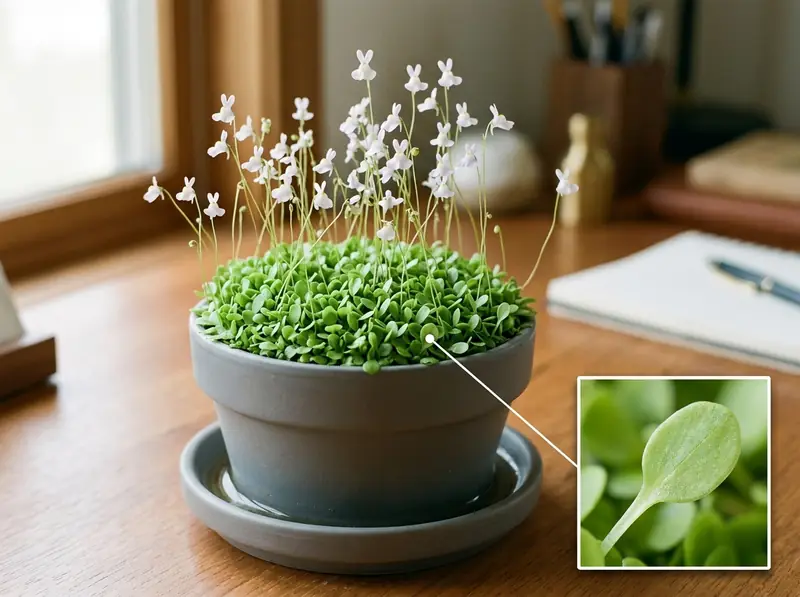
 AI-generated
Sanderson's Bladderwort
Utricularia sandersonii
Sanderson's bladderwort is a tiny carnivorous plant from South Africa with small paddle-shaped leaves and delicate white-to-lilac flowers that look like bunny ears. It grows in bog-like conditions and is easy to keep if you give it bright light and constantly wet soil with pure water. Never use tap water or fertilizer.
Saving is free with a KinClub account, and it works here and in the KinClub app. Sign up free
Care profile
- Light
- Bright, indirect lightLow → direct sun
- Water
- Keep moistAbout every 3 days
- Difficulty
- ModerateTricky → easy
- Coldest it tolerates
- 45°F
- Humidity
- Medium to high
- Mature size
- SmallSmall → tree-size
- Growth rate
- Moderate to fast
- How common
- EnthusiastRare → everywhere
- Plant family
- Lentibulariaceae
Pets and toxicity
Cats and dogs: not yet checked
Not yet checked against ASPCA — don't assume it's safe for pets.
No toxicity source on record for this plant yet. If a pet eats any houseplant, call your vet or an animal poison helpline.
How to care for Sanderson's Bladderwort
Light
Give it bright light with a few hours of gentle morning or filtered sun, such as an east window. Under grow lights, 12 to 14 hours a day works well.
Watering
Keep the soil constantly wet by standing the pot in about 1 inch of distilled, rainwater or reverse-osmosis water. Tap water minerals harm it, so use pure water only.
Soil
Use a nutrient-free, mineral-free mix of 1 part peat moss to 1 part perlite or silica sand. Avoid ordinary potting mix, compost and fertilized soils.
Feeding
Do not fertilize. It gets nutrients from tiny traps on its underground stolons, and fertilizer can burn the roots and cause algae.
Repotting
Repot or divide every 1 to 2 years in spring, when the clump fills the pot. Use a shallow 3 to 4 inch pot with fresh peat and perlite mix.
Propagation
Divide the clump in spring by teasing apart small sections with roots and leaves, then pot each in fresh wet peat and perlite mix. Each piece usually establishes within a few weeks.
Common problems
- Brown, crispy leaves: the soil dried out or the water was mineral-rich. Switch to distilled or rainwater and keep the tray filled.
- No flowers: light is too low. Move it to a brighter window or add a grow light, and keep the temperature at 60-80°F.
- Green algae or moss on the soil: too much fertilizer or mineral water. Scrape off the top layer, top up with fresh mix, and use only pure water.
- Fungus gnats hovering over the wet soil: use yellow sticky traps and avoid letting organic debris sit on the surface.
Similar plants
Same light needs and difficulty.
 AI-generated
 AI-generated
 AI-generated
 AI-generated