
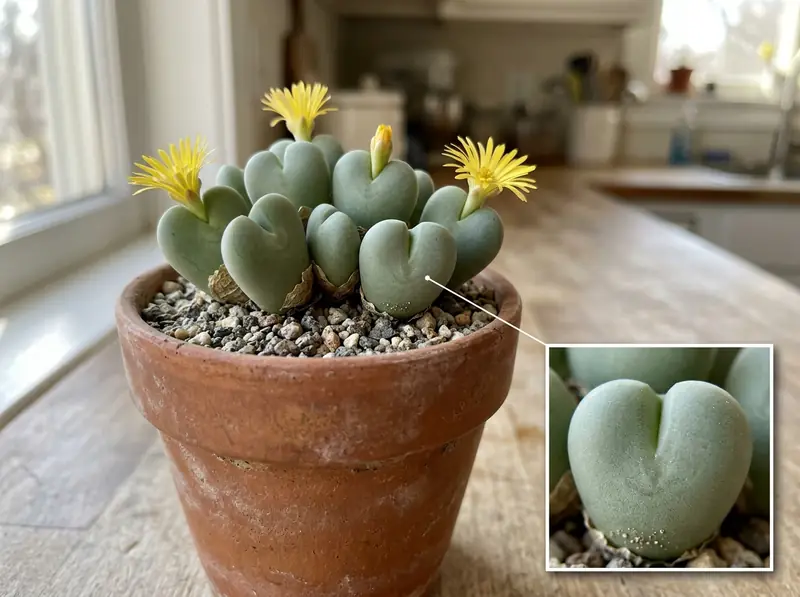
 AI-generated
Cone Plant
Conophytum bilobum
A tiny living-stone succulent that grows in small clusters of rounded, two-lobed bodies, with daisy-like flowers in fall. It needs strong sun, gritty soil and a dry summer rest, so it is a plant for patient growers.
Saving is free with a KinClub account, and it works here and in the KinClub app. Sign up free
Care profile
- Light
- Direct sunLow → direct sun
- Water
- Let it dry outAbout every 21 days
- Difficulty
- Moderate to challengingTricky → easy
- Coldest it tolerates
- 40°F
- Humidity
- Low
- Mature size
- SmallSmall → tree-size
- Growth rate
- Slow
- How common
- EnthusiastRare → everywhere
- Plant family
- Aizoaceae
Pets and toxicity
Cats and dogs: not yet checked
Not yet checked against ASPCA — don't assume it's safe for pets.
No toxicity source on record for this plant yet. If a pet eats any houseplant, call your vet or an animal poison helpline.
How to care for Cone Plant
Light
Give it plenty of bright light with several hours of direct sun, such as a south-facing window. Without enough sun the bodies stretch and lose their compact shape.
Watering
Water lightly about every 3 weeks during fall and winter growth, when the old pair of leaves is replaced. Stop watering completely in the dormant period from spring through summer.
Soil
Use a very gritty mix of mostly pumice, grit or coarse sand with only a little potting soil, in a shallow pot with drainage.
Feeding
Feed rarely, with a quarter-strength cactus fertilizer once or twice during fall growth. Overfeeding causes splitting.
Repotting
Repot only every 3 to 4 years in a shallow pot, during dormancy or in early fall, and keep it dry for a few days after.
Propagation
Divide an older clump into pieces with roots in late summer, or sow the fine seed on gritty mix, which is slow.
Common problems
- Bodies splitting open: too much water or feeding during growth. Cut back watering and fertilizer.
- Shriveled, papery outer leaves in summer: normal dormancy as the old leaves dry up. Do not water.
- White cottony patches between bodies: mealybugs. Dab with alcohol on a cotton swab.
Similar plants
Same light needs and difficulty.
 AI-generated
 AI-generated
 AI-generated
 AI-generated