
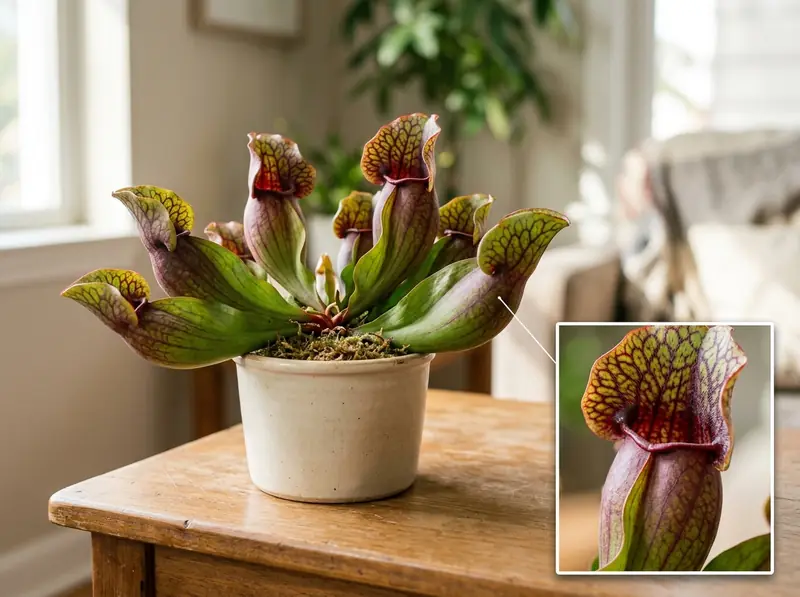
 AI-generated
Purple Pitcher Plant
Sarracenia purpurea
Purple pitcher plant is a hardy North American bog carnivore that forms a rosette of purple-veined, fluid-filled pitchers. It needs full sun, constantly wet roots and pure water. It also needs a cold winter dormancy, so it does best outdoors or in a cool, bright spot rather than a heated living room.
Saving is free with a KinClub account, and it works here and in the KinClub app. Sign up free
Care profile
- Light
- Direct sunLow → direct sun
- Water
- Keep moistAbout every 2 days
- Difficulty
- Moderate to challengingTricky → easy
- Coldest it tolerates
- 30°F
- Humidity
- Medium to high
- Mature size
- SmallSmall → tree-size
- Growth rate
- Slow
- How common
- Very commonRare → everywhere
- Plant family
- Sarraceniaceae
Pets and toxicity
Cats and dogs: not yet checked
Not yet checked against ASPCA — don't assume it's safe for pets.
No toxicity source on record for this plant yet. If a pet eats any houseplant, call your vet or an animal poison helpline.
How to care for Purple Pitcher Plant
Light
Needs at least 6 hours of direct sun daily; a south-facing window or a spot outdoors in summer is best. Strong grow lights can substitute indoors.
Watering
Keep the pot standing in about 1 inch of water in a tray during the growing season, topping up as it drops. Use only rainwater, distilled or reverse-osmosis water, since minerals in tap water build up and harm the roots.
Soil
Use a nutrient-poor mix of roughly equal parts peat moss and perlite or coarse sand. Never use regular potting soil or fertilized mixes.
Feeding
Do not fertilize the soil. The plant catches its own insects; if growing indoors, one small insect every month or so is plenty.
Repotting
Repot every 2-3 years in late winter before growth starts, into a pot only slightly bigger, using fresh peat and perlite. Rinse the roots gently and handle them as little as possible.
Propagation
Divide the rhizome into sections with roots and a growing point in late winter. Seed is possible but needs cold stratification for 4-8 weeks and takes several years to reach size.
Common problems
- Brown, dying pitchers in autumn are normal; trim them off once fully brown.
- Plant declining year after year: it probably lacks winter dormancy, so give it 3-4 months at about 35-50°F, such as in an unheated garage or outdoors.
- Crusty white buildup on the soil or browning tips: switch to rainwater or distilled water and flush the pot.
- Aphids or scale on pitchers or flower stalks: wipe off or spray with water, or use insecticidal soap sparingly on the affected parts.
Similar plants
Same light needs and difficulty.
 AI-generated
 AI-generated
 AI-generated
 AI-generated