
 AI-generated
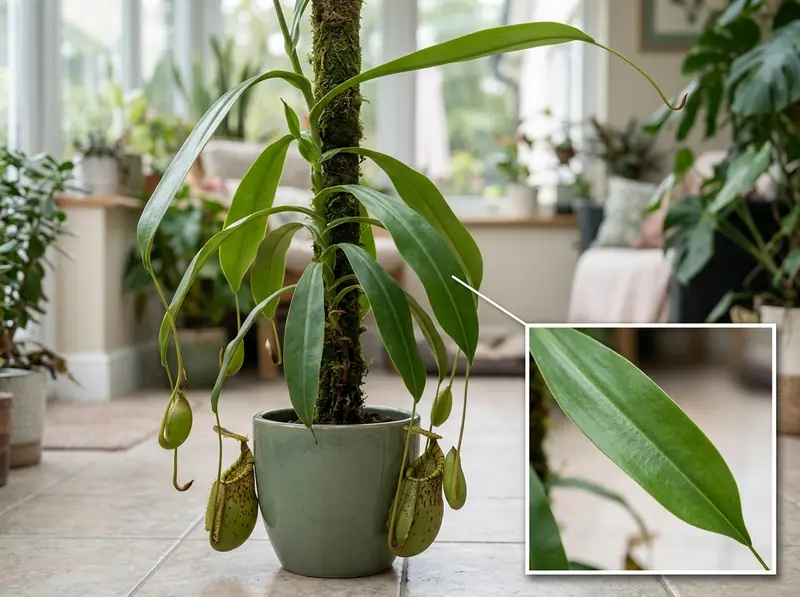
Fanged Pitcher Plant
Nepenthes bicalcarata
The fanged pitcher plant is a big Borneo species named for the two sharp teeth under each pitcher lid, and it famously shelters ants in its swollen tendrils. It needs warmth, humidity and pure water, so it is for experienced growers.
Saving is free with a KinClub account, and it works here and in the KinClub app. Sign up free
Care profile
- Light
- Bright, indirect lightLow → direct sun
- Water
- Keep moistAbout every 4 days
- Difficulty
- ChallengingTricky → easy
- Coldest it tolerates
- 60°F
- Humidity
- High
- Mature size
- LargeSmall → tree-size
- Growth rate
- Moderate
- How common
- RareRare → everywhere
- Plant family
- Nepenthaceae
Pets and toxicity
Cats and dogs: not yet checked
Not yet checked against ASPCA — don't assume it's safe for pets.
No toxicity source on record for this plant yet. If a pet eats any houseplant, call your vet or an animal poison helpline.
How to care for Fanged Pitcher Plant
Light
Prefers bright, indirect light, such as an east window or a spot with filtered sun, or a grow light for 12 hours. Strong light brings out the pitcher colors; avoid hot afternoon sun through glass.
Watering
Keep the mix evenly damp, never soggy, using distilled, rain or reverse-osmosis water; water every 3 to 5 days as the surface dries. Keep it warm, ideally 70 to 85°F.
Soil
Use a nutrient-poor, airy mix such as 1 part long-fibered sphagnum moss, 1 part perlite and 1 part orchid bark, in a pot with drainage holes. Avoid ordinary potting soil and fertilizer-laced mixes.
Feeding
Do not fertilize the soil. If it doesn't catch insects, add a pinch of a diluted orchid fertilizer to a few pitchers once a month, or just leave it.
Repotting
Repot every 1 to 2 years in spring when the mix breaks down, into a deep pot or basket with fresh sphagnum-based mix. Handle roots carefully.
Propagation
Stem cuttings with 2 to 3 nodes can root in damp sphagnum under high humidity and warmth, taking 2 to 4 months. It is slower and less reliable than hybrids.
Common problems
- Pitchers fail to form in dry or cool air; use a humidifier or terrarium and keep it above 65°F.
- Leaf tip browning is often tap water; switch to distilled water.
- Soggy cold mix causes root rot; use airy, fast-draining mix.
- Aphids and scale on new growth; wipe off and use insecticidal soap.
Similar plants
Same light needs and difficulty.
 AI-generated
 AI-generated
Calathea Orbifolia
Goeppertia orbifolia
- Medium to bright, indirect light
- Keep moist
Pets: not yet checked AI-generated
 AI-generated