
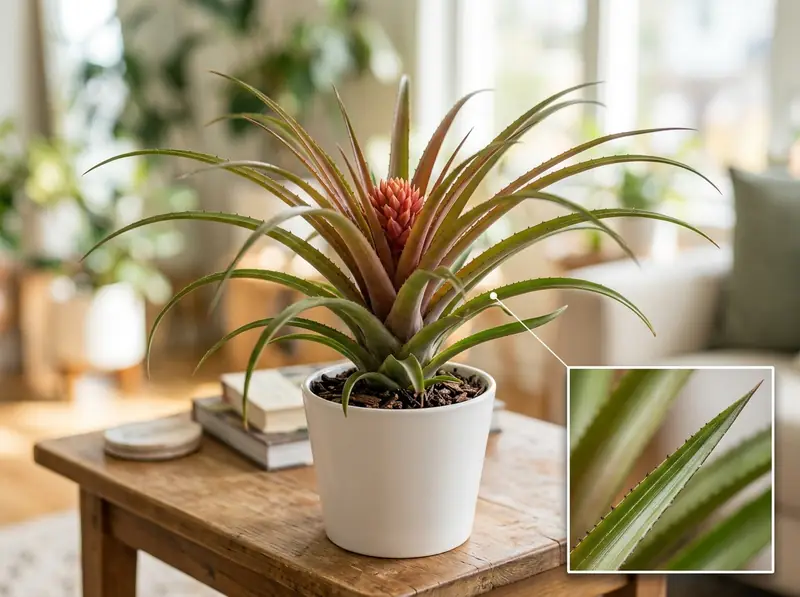
 AI-generated
Recurvata Bromeliad
Aechmea recurvata
Aechmea recurvata is a compact, stiff-leaved bromeliad that forms a tidy rosette and produces a long-lasting red, pink or orange flower at its centre. It's easy to grow in bright light with a little water in its central cup. After blooming, the parent slowly fades while producing pups to replace it.
Saving is free with a KinClub account, and it works here and in the KinClub app. Sign up free
Care profile
- Light
- Bright, indirect lightLow → direct sun
- Water
- Dry to moderate wateringAbout every 10 days
- Difficulty
- EasyTricky → easy
- Coldest it tolerates
- 50°F
- Humidity
- Medium
- Mature size
- SmallSmall → tree-size
- Growth rate
- Slow
- How common
- EnthusiastRare → everywhere
- Plant family
- Bromeliaceae
Pets and toxicity
Cats and dogs: not yet checked
Not yet checked against ASPCA — don't assume it's safe for pets.
No toxicity source on record for this plant yet. If a pet eats any houseplant, call your vet or an animal poison helpline.
How to care for Recurvata Bromeliad
Light
Give bright light, including a few hours of gentle morning sun from an east window, or bright indirect light near a south or west window. Strong afternoon sun through glass can scorch the leaves.
Watering
Keep the central cup about a quarter full of water and flush it every week or so. Water the potting mix lightly only when the top inch is dry, roughly every 10 days in summer and less in winter.
Soil
Use a very open, fast-draining mix such as orchid bark blended with a little peat-free potting soil and perlite. It can also be grown mounted on bark.
Feeding
Feed lightly during spring and summer with a balanced fertilizer diluted to quarter strength, applied to the soil or cup once a month. Do not feed in winter.
Repotting
Rarely needed because the root system is small. Move to a slightly larger pot only if the plant becomes top-heavy, ideally in spring, using a shallow pot with drainage holes.
Propagation
Remove pups when they are about one-third the size of the parent, cutting close to the base with a clean knife. Let the cut dry a day, then pot in a bark-based mix. The parent plant slowly dies after flowering.
Common problems
- Brown, mushy centre: rot from stale or cold water in the cup, so empty it, let it dry slightly, and refill with fresh water less often.
- Brown leaf tips: dry air or mineral build-up from hard water, so use rainwater or filtered water and mist occasionally.
- No bloom: plant is too mature or receiving low light, so move to brighter light; a plant in an enclosed bag with a ripe apple for a week can trigger blooming.
- Scale or mealybugs: white or brown bumps along leaf bases, so wipe off with rubbing alcohol on a cotton swab and repeat weekly.
Similar plants
Same light needs and difficulty.
 AI-generated
Chinese Money Plant
Pilea peperomioides
- Bright, indirect light
- Dry to moderate watering
Pets: not yet checked AI-generated
Christmas Cactus
Schlumbergera × buckleyi
- Bright, indirect light
- Moderate watering
Pets: not yet checked AI-generated
 AI-generated