
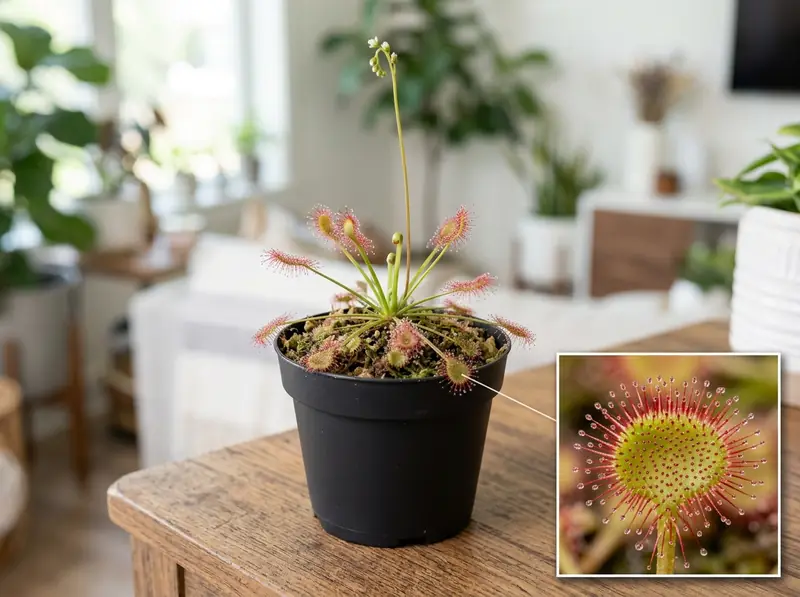
 AI-generated
Round-Leaved Sundew
Drosera rotundifolia
Round-leaved sundew is a small carnivorous plant whose rounded leaves are covered in sticky red tentacles that trap tiny insects. It needs pure water, bright light and a cool winter rest, so it suits a dedicated bog-style setup.
Saving is free with a KinClub account, and it works here and in the KinClub app. Sign up free
Care profile
- Light
- Direct sunLow → direct sun
- Water
- Keep moistAbout every 3 days
- Difficulty
- Moderate to challengingTricky → easy
- Coldest it tolerates
- 20°F
- Humidity
- Medium to high
- Mature size
- SmallSmall → tree-size
- Growth rate
- Slow to moderate
- How common
- EnthusiastRare → everywhere
- Plant family
- Droseraceae
Pets and toxicity
Cats and dogs: not yet checked
Not yet checked against ASPCA — don't assume it's safe for pets.
No toxicity source on record for this plant yet. If a pet eats any houseplant, call your vet or an animal poison helpline.
How to care for Round-Leaved Sundew
Light
Very bright light, ideally 4 or more hours of direct sun or a strong grow light. Bright light gives the leaves their red color and plentiful dew.
Watering
Keep the pot sitting in 1 inch of distilled, rainwater, or reverse osmosis water at all times in the growing season. Tap water minerals build up and kill it.
Soil
Unfertilized peat moss mixed half and half with perlite or silica sand. Do not use ordinary potting soil or add fertilizer.
Feeding
Do not fertilize. It catches small insects on its own, and fertilizer burns the roots; an occasional gnat is plenty.
Repotting
Repot every 2 years in late winter into fresh peat and perlite. Move it before new growth begins.
Propagation
Divide clumps in spring, take leaf cuttings laid on damp peat, or sow the tiny seed on peat. Leaf cuttings take several weeks and need high light.
Common problems
- This species needs a cool winter rest of 40 to 50 F, with the plant forming a tight winter bud; without it the plant declines in a year or two.
- Hard water leaves mineral crust and brown roots: switch to rainwater or distilled water.
- Aphids or gnats appear on weak plants: rinse with water or use yellow sticky traps.
Similar plants
Same light needs and difficulty.
 AI-generated
 AI-generated
 AI-generated
 AI-generated