
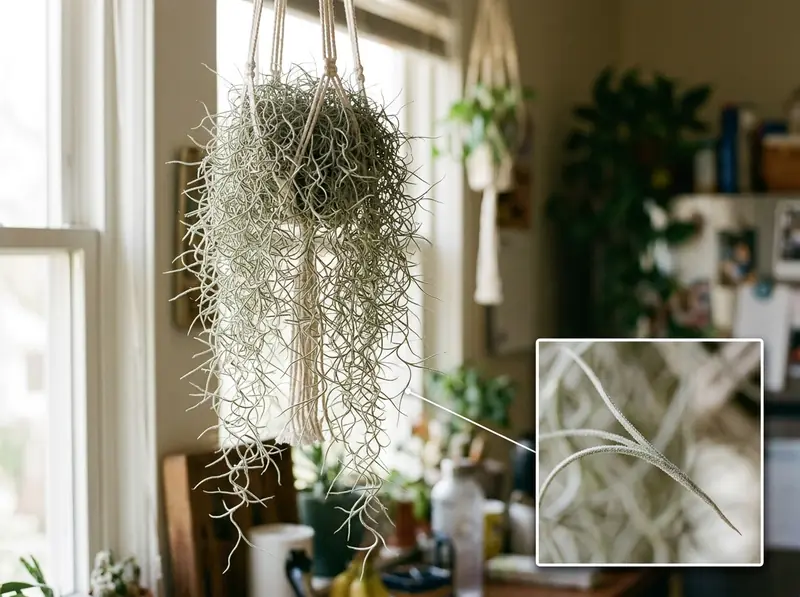
 AI-generated
Spanish Moss
Tillandsia usneoides
Spanish Moss is a trailing air plant that drapes in silvery-gray strands and takes in water and nutrients through its leaves, not roots. Hang it in bright, indirect light with good air movement, soak or mist it regularly, and let it dry fully within a few hours. It is easy to share since any snipped piece will grow on.
Saving is free with a KinClub account, and it works here and in the KinClub app. Sign up free
Care profile
- Light
- Bright, indirect lightLow → direct sun
- Water
- Moderate to moist wateringAbout every 7 days
- Difficulty
- ModerateTricky → easy
- Coldest it tolerates
- 40°F
- Humidity
- Medium to high
- Mature size
- MediumSmall → tree-size
- Growth rate
- Moderate
- How common
- CommonRare → everywhere
- Plant family
- Bromeliaceae
Pets and toxicity
Cats and dogs: not yet checked
Not yet checked against ASPCA — don't assume it's safe for pets.
No toxicity source on record for this plant yet. If a pet eats any houseplant, call your vet or an animal poison helpline.
How to care for Spanish Moss
Light
Give it bright, indirect light, such as a spot near an east or south window with some filtering. A little gentle morning sun is fine, but hot midday sun through glass can scorch it.
Watering
Soak in room-temperature water for 10-20 minutes about once a week, or mist thoroughly 2-3 times a week in dry air. Shake off extra water and make sure it dries within about 4 hours. Rain or filtered water is best if your tap water is hard.
Soil
It is an air plant and needs no soil. Hang it, drape it over a branch, or set it loosely on a shelf where air circulates freely. Avoid packing it into a pot or leaving it in a damp, closed container.
Feeding
Feed lightly once a month in spring and summer with a bromeliad or air-plant fertilizer diluted to 1/4 strength, added to the soaking water. Skip feeding in winter.
Repotting
No repotting is needed because it grows without soil. Just re-hang it, and trim off any dead, blackened sections as they appear. Loosen dense clumps occasionally to let air reach the middle.
Propagation
Easy: pull off or snip a piece of strand 4-6 inches long and drape it over a support or tuck it into the main clump. It will grow on its own. Just keep it watered like the parent.
Common problems
- Gray-black, mushy strands mean it stays wet too long. Trim off the dead parts, soak less often, and improve air flow so it dries within 4 hours.
- Brittle, silvery, shrunken strands mean it is too dry. Soak for 30 minutes and then mist more often.
- Yellowed, bleached strands mean too much direct sun. Move it back from the window or filter the light with a sheer curtain.
- Cottony white bumps are mealybugs. Dab them with rubbing alcohol on a swab or rinse the plant, then check again weekly.
- Dull, slow growth is often caused by low light or cold drafts. Move it to a brighter, warmer spot with gentle air movement.
Similar plants
Same light needs and difficulty.
 AI-generated
 AI-generated
 AI-generated
 AI-generated